1. Product Overview
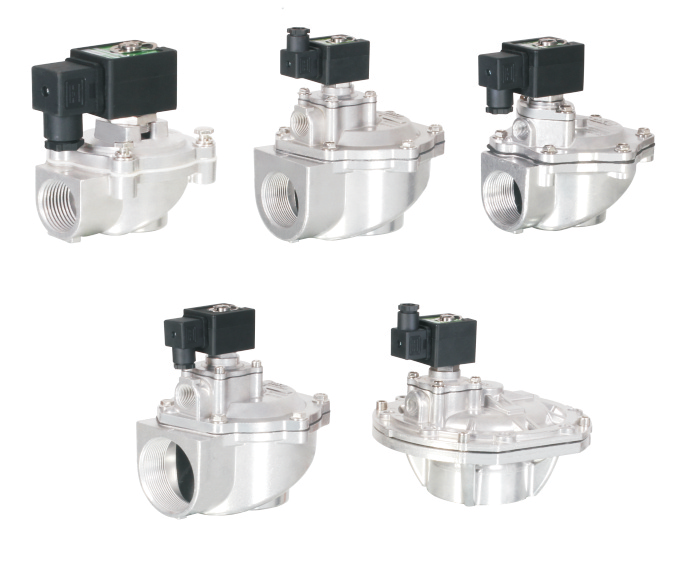
The IndusKey IK1108 is a dusting pulse solenoid valve for clean compressed air, built with a pilot-operated diaphragm structure and a full aluminium body. Designed as a low-power, low-voltage pulse-duty solution, the IK1108 is the first-choice valve for baghouse (bag filter) dust removal and soot-blower systems in pharmaceutical, paper, timber, feed processing and petro-chemical plants.
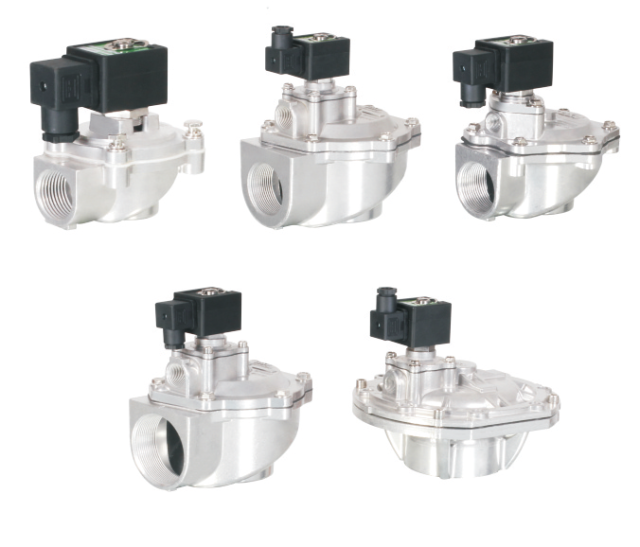
Five models cover orifices from 25 mm to 76 mm (ports 1" to 2-1/2", including a 76Y submerged type for tank installation), with operating pressure 0.3–0.8 MPa and two enclosed coil options (S044 / S051, IP65, 100% ED). The full-aluminium construction cuts cost and weight versus brass or stainless alternatives, while the special rubber diaphragm and stainless-steel internals ensure reliable pulse operation in dusty industrial environments.
2. Working Principle
The IK1108 uses a pilot-operated diaphragm structure:
-
Standby (NC) — The main diaphragm is held closed by spring force and control-chamber pressure; the valve is normally closed.
-
Pulse firing — Energizing the small solenoid pilot opens the vent orifice: control-chamber pressure exhausts faster than it can be replenished through the fixed restrictor, creating a pressure differential across the diaphragm.
-
Full lift — Line pressure lifts the main diaphragm instantly, releasing a short, high-velocity pulse of clean compressed air into the blow pipe — the shock wave flexes the filter bags and dislodges accumulated dust.
-
Reset — De-energizing the pilot re-pressurizes the control chamber; the diaphragm reseats and the valve returns to the closed state, ready for the next pulse.
The fully enclosed coil and special rubber diaphragm maintain reliable operation in dusty ambient conditions, and 100% ED rating supports frequent pulsing sequences controlled by a sequential timer or PLC.
3. Key Features & Competitive Advantages
A. Pulse Jet Operation
B. Full Aluminium Body
C. Low Power, Low Voltage
D. Special Rubber Diaphragm
E. Five Sizes + Submerged Type
F. Stainless Internals
-
SS304 armature tube, SS430F plunger/stop, SS304 springs, copper shading rings — corrosion-proof magnetic circuit.
G. Fully Enclosed IP65 Coils
H. Direct Replacement Design
4. Technical Specifications
| Configuration |
|
| Valve Type |
2/2-way, pilot-operated diaphragm, pulse duty |
| Function |
Normally closed (NC) |
| Port Size |
1", 1-1/2", 2", 2-1/2"; 76Y submerged type |
| Connection |
BSPP (G), BSPT, NPT, Y (submerged) |
| Orifice |
25 / 40 / 50 / 62 / 76 mm |
| Models |
IK1108-25 (1") · IK1108-40 (1-1/2") · IK1108-50 (2") · IK1108-62 (2-1/2") · IK1108-76Y (submerged) |
| Performance |
|
| Operating Pressure |
0.3 ~ 0.8 MPa |
| Medium |
Clean compressed air |
| Medium Temperature (NBR seal) |
−5℃ ~ +55℃ |
| Electrical |
|
| Supply Voltage |
AC 220V / 110V / 24V; DC 24V / 12V |
| Voltage Tolerance |
±10% |
| Coil S044 |
20 VA (AC) / 20 W (DC); IP65; 100% ED |
| Coil S051 |
18 VA (AC) / 24 W (DC); IP65; 100% ED |
| Materials |
|
| Body |
Aluminium (full aluminium) |
| Seals |
NBR or special rubber (T) |
| Armature Tube |
Stainless steel 304 |
| Plunger / Stop |
Stainless steel 430F |
| Springs |
Stainless steel 304 |
| Shading Rings |
Copper |
| Dimensions (mm) |
|
| IK1108-25 (DN25) |
A=124, B=88, C=74 |
| IK1108-40 (DN40) |
A=162, B=131, C=117 |
| IK1108-50 (DN50) |
A=202, B=205, C=184 |
| IK1108-62 (DN62) |
A=222, B=210, C=185 |
| IK1108-76Y (submerged) |
Height 167; flange Ø226 (8×Ø11.5 holes on Ø195 PCD); pipe Ø88; Ø171 base |
5. Applications
The IndusKey IK1108 is engineered for industrial dust-collection and pulse-jet cleaning systems:
-
Baghouse Dust Collectors: Pulse-jet cleaning of bag filters in cement, powder handling and bulk processing plants.
-
Soot Blower Systems: Pulse air for boiler and heater soot-blowing applications.
-
Pharmaceutical Manufacturing: Dust extraction on tablet presses, granulators and powder filling lines (drug factory applications).
-
Paper Mills: Bag filter cleaning on paper and pulp dust-collection systems.
-
Timber Mills: Wood-dust extraction and filter cleaning in sawmills and panel plants.
-
Feed Processing: Grain and feed dust collection in milling and feed plants.
-
Petro-Chemical Dust Removal: Dust control on catalyst handling, lime and powder processes.
-
OEM Dust Remover Equipment: Standard fit for domestic and export dust-removal equipment builders.
6. Selection, Ordering & Installation Guidelines
Model Code System
The full valve is configured by a 7-field code — example: IK1108-25GAN S044-1 (25mm orifice, G-thread, aluminium body, NBR seal, S044 coil, AC220V)
| Type |
IK1108 |
Series, NC pulse valve |
| Orifice |
25 / 40 / 50 / 62 / 76 |
Orifice (mm) — 25: 1" · 40: 1-1/2" · 50: 2" · 62: 2-1/2" · 76: 76Y submerged |
| Port Thread |
G / N / Y |
G: BSPP · N: NPT · Y: submerged |
| Body |
A |
A: Aluminium |
| Seal |
N / T |
N: NBR · T: special rubber |
| Coil |
S044 / S051 |
Enclosed coils, IP65, 100% ED |
| Voltage |
1–5 |
1: AC220V · 2: DC24V · 3: AC110V · 4: DC12V · 5: AC24V |
Note: BSPT connections also available — confirm at order.
Selection
-
Pressure: Confirm compressed-air supply within 0.3–0.8 MPa — the pilot diaphragm requires this range for full lift and reliable reseating.
-
Size: Match orifice/port to blow-pube and venturi design (standard baghouse pairing: 25 mm for single-row small bags, up to 76Y for large filter tanks).
-
Coil: S044 and S051 are interchangeable in envelope; select by control-voltage and power preference (S051 has higher DC holding power).
-
Seal: NBR standard; special rubber (T) for extended diaphragm life in aggressive dust.
Installation
-
Threaded types (25–62): Mount on the blow tube with coil upright or sideways per available clearance; seal threads with PTFE tape; observe flow direction (inlet from air receiver, outlet to blow pipe).
-
Submerged type (76Y): Bolt directly to the filter tank flange using the 8×Ø11.5 hole pattern on the Ø195 PCD; ensure the Ø88 outlet pipe seats properly into the blow tube.
-
Wiring: Enclosed IP65 coils with DIN connector; route cables away from high-temperature flue zones.
-
Air quality: Supply must be clean, dry compressed air — install filtration and automatic drains on the receiver to protect the pilot orifice and diaphragm.
Operation & Maintenance
-
100% ED rated for continuous availability; actual pulsing is controlled by the sequential timer (typical pulse width 80–150 ms).
-
Inspect diaphragms annually in continuous service; the special rubber diaphragm is a wear part and is field-replaceable.
-
Keep spare diaphragm kits and coil assemblies in stock to minimize collector downtime.