1. Product Overview
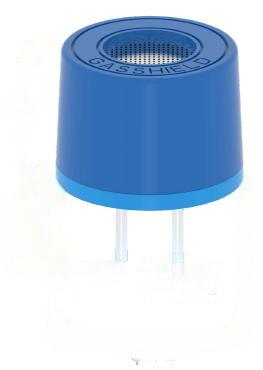
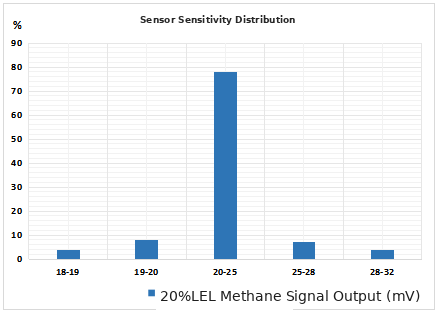
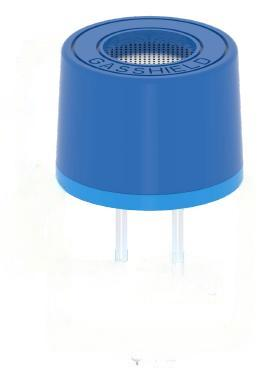
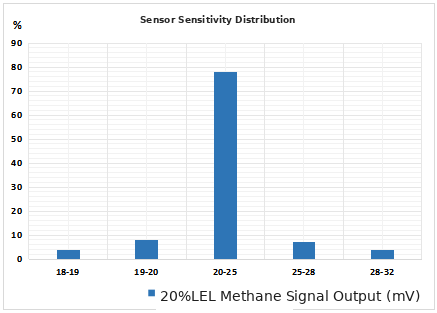
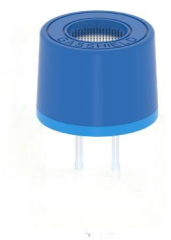
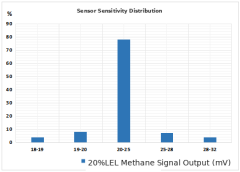
The GASSHIELD UGT-C6 is a low-power catalytic combustion-type combustible gas sensor designed for accurate and reliable detection of Methane (CH₄), Propane (C₃H₈), Butane (C₄H₁₀) and most combustible gases and vapors. With a detection range of 0–100% LEL, output sensitivity of 18–32 mV at 20% LEL methane, and ultra-low power consumption of only 90–110 mA, the UGT-C6 delivers fast, precise combustible gas detection with dramatically reduced energy demand — ideal for battery-powered and energy-sensitive applications.
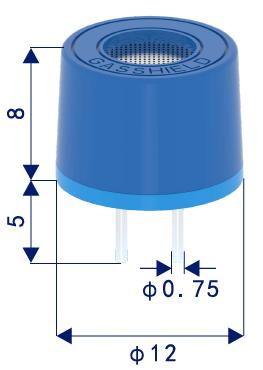
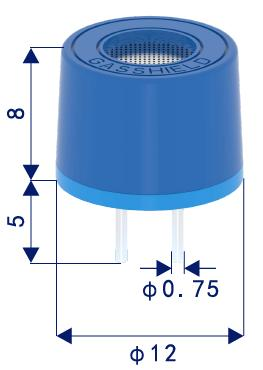
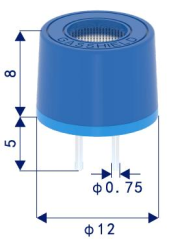
The sensor operates on the proven catalytic combustion principle with a Wheatstone bridge circuit, providing superior linearity (±3%), excellent repeatability and 5-year operating life in clean air. With excellent poisoning resistance and stable output across −25°C to +55°C, the compact Φ12 mm UGT-C6 is the optimal choice for portable gas detectors, wireless gas monitors, IoT gas sensing nodes and other applications where power budget is critical.
2. Technical Principle
The UGT-C6 employs a catalytic combustion (pellistor) detection principle. The sensor consists of a matched pair of elements — a catalytic (detection) element and a reference (compensation) element — arranged in a Wheatstone bridge circuit.
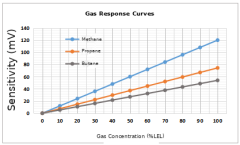
When combustible gas diffuses into the sensor and contacts the catalytic element, it oxidizes on the heated catalyst surface, causing a rise in element temperature and resistance. The reference element, coated with inert material, remains unaffected by the gas, compensating for ambient temperature and humidity variations. The resulting resistance imbalance in the bridge generates a voltage output proportional to the gas concentration, delivering a linear response from 0 to 100% LEL.
The sensor exhibits excellent directional stability: when rotated 360° in the vertical direction, the output signal change is limited to ±0.5% LEL, ensuring consistent readings regardless of installation orientation.
3. Key Features & Competitive Advantages
A. Ultra-Low Power Consumption
-
Operating current as low as 90 mA (<310 mW) — roughly half the power of standard catalytic sensors.
-
Ideal for battery-powered portable detectors, wireless sensor networks and IoT applications.
B. Multi-Gas Detection Capability
-
Responds to Methane, Propane, Butane, Hydrogen, Ethanol and a wide range of combustible gases and vapors — 26 gases characterized in the relative sensitivity table.
-
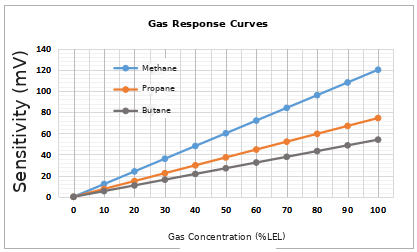
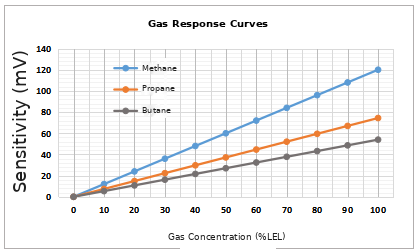
Near-linear output across the full 0–100% LEL range — see performance curves in Section 5.
C. Fast Response & Recovery
-
T90 < 10 s at 50% LEL methane for rapid leak detection.
-
Recovery time of only 15 s, enabling continuous monitoring cycles.
D. Good Long-Term Working Stability
E. Excellent Poisoning Resistance
F. Excellent Repeatability
G. Wide Operating Environment
H. Compact Size, Cost-Effective
4. Technical Specifications
Relative Sensitivity to Common Gases (%): Methane 100 | Ammonia 110 | Hydrogen 72 | Ethylene 69 | Propane 55 | Dimethyl ether 55 | Ethane 54 | Diethyl ether 54 | Ethanol 52 | Isobutane 49 | Butane 44 | Hexane 42 | Acetone 42 | Isobutanol 40 | Butanone 40 | Heptane 38 | Cyclohexane 37 | Ethyl acetate 37 | Octane 37 | Toluene 35 | Pentane 35 | n-Octane (Gasoline) 35 | Acetic acid 35 | n-Pentane 33 | Methanol 27 | Chloromethane 23
Note: Relative sensitivity values may vary with production batch and test environment. Calibrate with the target gas before use.
5. Applications
The GASSHIELD UGT-C6 is engineered for versatile deployment across battery-powered and energy-sensitive combustible gas detection scenarios:
-
Portable Gas Detectors: Personal and handheld combustible gas monitors with extended battery life.
-
Wireless & IoT Monitoring: Battery-powered wireless gas sensor nodes for smart city, smart home and industrial IoT networks.
-
Industrial Safety: Gas detection in oil & gas, petrochemical and chemical processing facilities with limited power supply.
-
Gas Leak Detection: Natural gas (methane) and LPG (propane/butane) leak alarms for residential and commercial applications.
-
Commercial & Catering: Kitchen gas leak detection in restaurants, hotels and canteens.
-
Wastewater & Environmental: Methane monitoring in sewage treatment plants, landfills and biogas facilities.
6. OEM Integration & Design Guidelines
To maximize design flexibility and ensure optimal sensor performance, the UGT-C6 is supported by comprehensive integration resources and handling guidelines for equipment manufacturers.
-
Basic Circuit Reference: Standard Wheatstone bridge circuit (Vin+/Vin− power input, Vout+/Vout− differential output) with recommended reference detection circuit provided for immediate PCB design integration. Recommended operating voltage: DC 2.8 V.
-
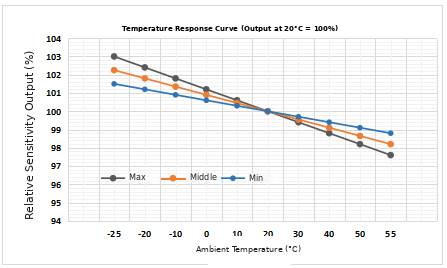
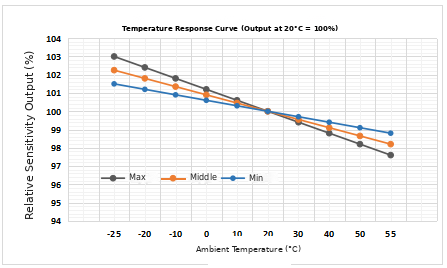
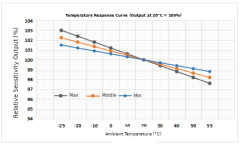
Temperature Compensation: See Section 5.2 for the temperature response curve (−25°C to +55°C, zero-compensated) to guide firmware compensation algorithms.
-
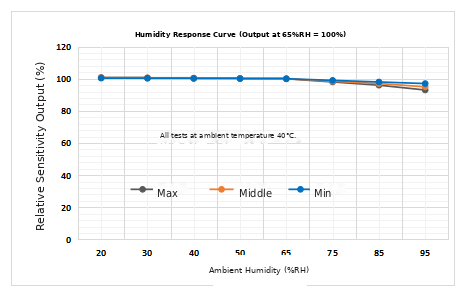
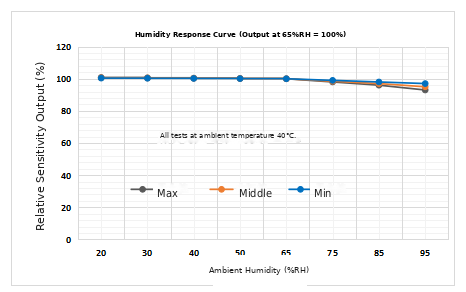
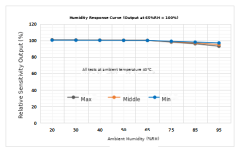
Humidity Compensation: See Section 5.3 for humidity response data (20–95% RH) for environmental robustness design.
-
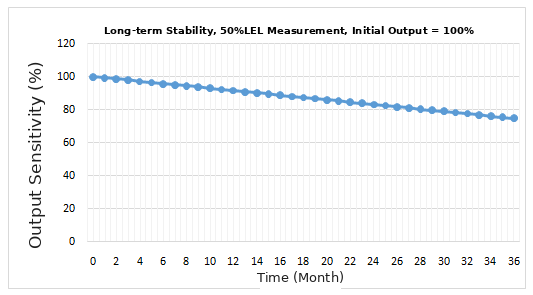
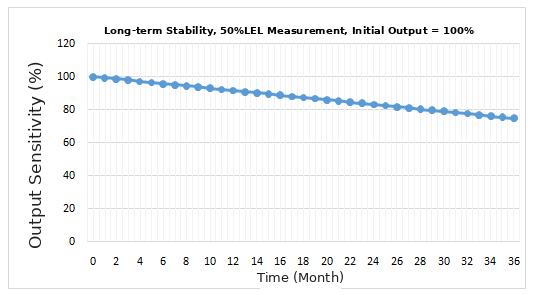
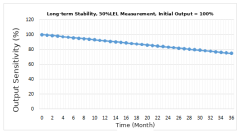
Response & Recovery Characterization: See Sections 5.1 and 5.6 for gas response and long-term drift data to optimize alarm thresholds and calibration intervals.
-
Gas-Specific Calibration: Use the Relative Sensitivity Table (Section 4) to convert readings between calibration gas and target gas: Detector reading = calibration gas concentration × (calibration gas coefficient ÷ target gas coefficient). Calibrate with the target gas before use; cross-sensitive gas calibration cannot guarantee measurement accuracy.
-
Handling Precautions (Important):
-
Handle with care: To achieve ultra-low power consumption, a thinner platinum wire is used, so vibration resistance is slightly weaker than the UGT-C5. Avoid strong vibration and do not drop from a height of more than 60 cm.
-
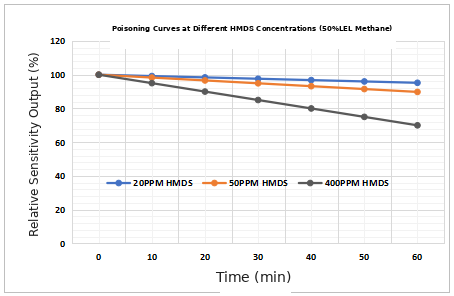
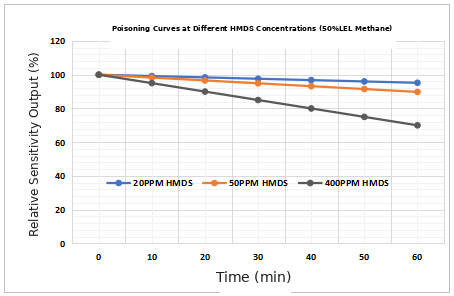
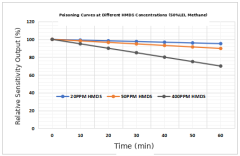
Avoid prolonged exposure to silicones, HMDS, lead compounds, sulfur compounds and other catalyst poisons.
-
Avoid contact with organic solvents, alcohol, paints and oils.
-
Do not exceed rated operating voltage/current to prevent catalyst damage.
-
Calibrate with standard gas (e.g., 50% LEL methane) in clean air background with stable, gentle gas flow.